Agent activity
Checking for WebMCP support
Requests are only sent after you confirm them. How this works
Deployment architecture
Hybrid deployment: process locally, report centrally
In short
Hybrid deployment processes video locally at each site while aggregating events and metrics centrally. Local alerting continues through a WAN outage, and the centre gets comparable measurement across the estate. It suits multi-site organisations that need both site autonomy and portfolio-level reporting.
Who this suits
- Retail, logistics and property estates with many comparable sites
- Organisations needing estate-wide comparison without centralising video
- Deployments where local alerting must survive a WAN interruption
- Estates with varying site sizes, where per-site processing capacity differs
- Organisations wanting one rule template applied consistently across sites
Architecture
How it is put together
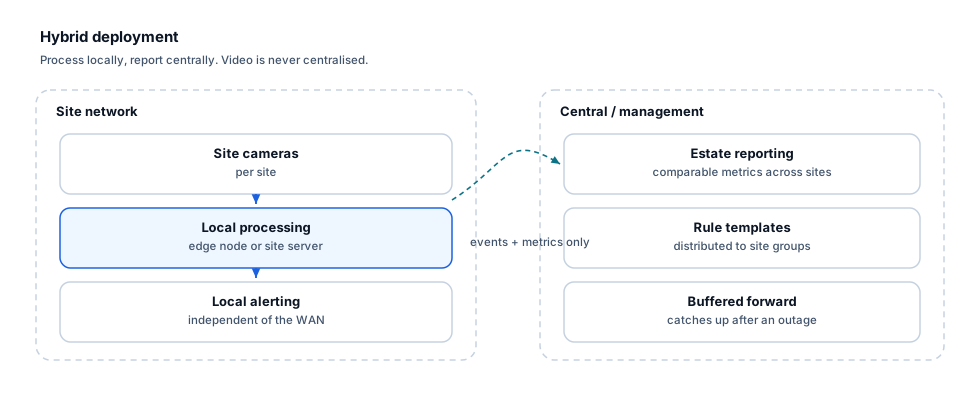
- Each site runs local processing — edge node or local server — consuming its own cameras.
- Rules are evaluated locally and local delivery paths operate independently of the WAN.
- Events and aggregate series are forwarded to a central layer for estate reporting.
- Configuration and rule templates are distributed from the centre to sites.
- Video itself is not centralised; only events, evidence references and metrics move.
Characteristics
What this model means in operation
The properties below are what actually differentiate the deployment models from each other.
- Bandwidth
- Low and predictable. Only events and aggregate series cross the WAN, so bandwidth scales with activity rather than with camera count or resolution.
- Latency
- Local alerting is as fast as edge or on-premise deployment because it involves no WAN round trip. Central reporting latency depends on the forwarding interval, which is a configuration choice rather than a constraint.
- Privacy
- Video stays at each site. Central systems hold events, evidence references and aggregate metrics, which is a materially smaller data-protection footprint than centralising video.
- Resilience
- Sites operate independently during a WAN outage and forward buffered events when connectivity returns. A central-layer outage does not stop site-level detection or alerting.
- Central management
- The main advantage of this model. Rule templates, thresholds and software versions are managed centrally and applied consistently, which is what makes estate-wide comparison meaningful rather than merely possible.
- Software updates
- Staged by site group from the centre, with the ability to pilot a version on a small group before estate rollout and to hold a version on sites that must not change.
- Health monitoring
- Central visibility of per-site, per-node and per-camera health. A site that stops reporting is surfaced immediately, which in a large estate is the difference between knowing and assuming.
- Logging
- Local structured logging with central aggregation of operational events. Media never leaves the site and personal data is redacted before forwarding.
- Backup
- Configuration and rule templates are held centrally, so a replaced site node can be restored from the central definition. Local evidence follows each site’s retention policy.
- High availability
- Site-level redundancy where individual sites justify it, plus central-layer redundancy. The architecture degrades gracefully: losing the centre costs reporting, not detection.
- Scaling
- Scales well to large estates because processing grows per site while the central layer handles events and metrics rather than video. This is usually the practical limit-breaker for estates of hundreds of sites.
Planning
Sizing inputs, cost and limitations
Hardware sizing inputs
- Number of sites and the camera count at each
- Per-site stream resolution and required analysis frame rate
- Rule count per camera and how much it varies between site formats
- Event volume per site, which drives central-layer sizing
- Aggregate series retention at the centre
- WAN characteristics at the least-connected sites, which set the forwarding design
Sizing is done against your actual stream profiles and rule set by Ayonix. No channel-count or throughput figure is published on this site, because none has been supplied.
Cost considerations
- Per-site hardware, which dominates in estates with many small sites
- Central platform cost, amortised across the estate
- Low and predictable WAN cost compared with centralising video
- Reduced per-site operations effort because configuration is managed centrally
- Rollout cost per site, which is often the largest project-phase expense
Limitations
- Per-site capacity is still bounded by the hardware at that site.
- Analysis requiring raw video from several sites at once is not possible without moving video.
- The central layer becomes an important dependency for reporting and must be designed accordingly.
- Consistency depends on rule templates being genuinely maintained centrally rather than drifting per site.
Frequently asked questions
What is centralised in a hybrid deployment?
Events, evidence references, aggregate series, configuration and health — not video. That distinction is what keeps bandwidth predictable and the data-protection footprint small while still giving the centre comparable measurement across sites.
What happens during a WAN outage?
Sites continue detecting, evaluating rules and delivering local alerts. Events are buffered and forwarded when connectivity returns, so the central record catches up rather than losing the period.
How is consistency maintained across sites?
Through centrally-managed rule templates. Templates transfer; tuning does not, because camera geometry differs. Each site still needs its own readiness review and threshold validation even where the rule design is identical.
Compare with other models
-
Edge video analytics
Run analytics next to the cameras so video stays on site, alerts survive a WAN outage and only…
-
On-premise video analytics
Run analytics on your own servers inside your network, alongside an existing VMS, with full co…
-
Air-gapped video analytics
Run analytics with no outbound connectivity for defence, utilities and regulated operational n…
-
Multi-site video analytics
Manage rules, thresholds, updates and health across many sites so measurement is comparable an…
-
ATLAS AIBOX
What Ayonix publishes about ATLAS BOX and ATLAS AIBOX edge hardware, how it fits an edge analy…
- Author
- Gabriel Bamola, Chief Marketing Officer, Ayonix
- Technical review
- Dr Sadi Vural, Founder and Chief Executive Officer, Ayonix
- Published
- Last reviewed
Get an architecture review for your estate
Site count, connectivity, data-residency constraints and whether alerting must survive an outage decide the model. An architecture review works through those with you and produces the sizing inputs Ayonix needs.