Agent activity
Checking for WebMCP support
Requests are only sent after you confirm them. How this works
Industry
Video analytics for car parks without a sensor in every bay
In short
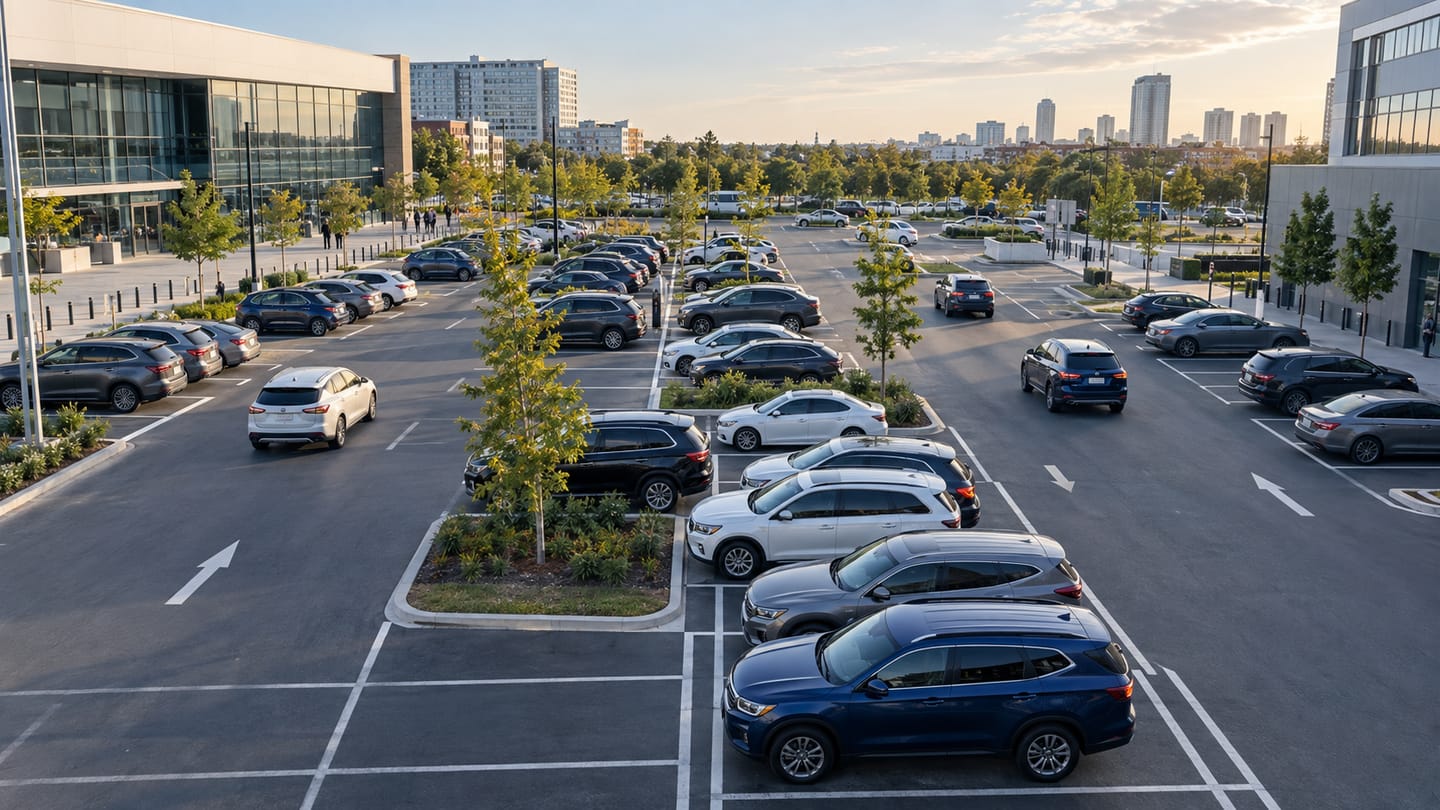
Parking video analytics reports live and historic occupancy from existing cameras, using Ayonix vehicle detection over bay or area zones. It removes the per-bay sensor cost and civil works, and keeps plate recognition as a separate decision with its own lawful basis.
The problem
What parking teams are dealing with
- Drivers circulate hunting for spaces while whole areas sit empty, and the operator cannot tell them where to go.
- Per-bay sensors were quoted and the capital and installation cost ended the business case.
- Occupancy is known only from barrier counts, which miss anyone who entered before the count was reset.
- Overstay is suspected but no record exists of how long bays are actually held.
- Multi-storey decks have no per-level visibility, so signage sends drivers to full levels.
Recommended
Analytics that address these problems
Only capabilities Ayonix publishes appear here. Each links to its full scope, camera requirements and limitations.
- Solution-design configuration
Parking occupancy analytics
Parking occupancy analytics uses Ayonix vehicle detection over defined bay or area zones to report how full a car park is, live and over time. Becau…
Read the detail → - Published capability
Vehicle detection
Ayonix vehicle detection identifies vehicles in parking areas and monitored locations from an existing camera view, and tracks them between frames. …
Read the detail → - Solution-design configuration
Vehicle counting
Vehicle counting applies directional line crossing to tracked vehicles, producing counts by direction and interval at entrances, lanes and access ro…
Read the detail → - Published capability
ANPR / licence plate recognition
ANPR reads vehicle licence plates from a camera view and converts them to text for access, parking and logistics workflows. Ayonix lists ANPR among …
Read the detail → - Solution-design configuration
Line crossing detection
Line crossing detection raises an event when a tracked object crosses a virtual line drawn on the camera view in a configured direction. Ayonix peop…
Read the detail → - Solution-design configuration
Dwell time alerting
Dwell time alerting raises an event when a tracked person or vehicle remains inside a defined area for longer than a configured threshold. Ayonix dw…
Read the detail →
Camera placement
Where cameras need to be, and why
Camera position decides more of the outcome than any software setting. These are the placements that matter in this sector.
| Location | Purpose | What matters |
|---|---|---|
| Each deck or surface area | Area occupancy | Height is the single biggest factor — a low view cannot see past the front row when the area is full. |
| Entry and exit lanes | Vehicle counting and direction | Across the lane rather than along it, away from habitual queueing points. |
| Controlled access lanes | Plate reading where justified | A dedicated ANPR camera per lane with controlled approach speed and dedicated illumination. |
| Restricted and accessible bays | Presence and dwell | These bays usually justify per-bay treatment where the general area does not. |
| Pedestrian routes | Conflict visibility where required | Only where a shared-route safety question genuinely exists. |
Workflow
From event to acknowledged action
Event workflow
- 1 Deck and lane cameras are ingested and monitored for availability.
- 2 Vehicles are detected and tracked; bay and area polygons are evaluated with a stationary threshold.
- 3 Occupancy is derived per area and compared against reconciled capacity.
- 4 Threshold states drive entrance and deck signage in near real time.
- 5 Occupancy and dwell series are retained for utilisation planning.
- 6 Where ANPR is deployed, reads are handled under separate retention and access rules.
Operator workflow
- 1 Entrance signage shows per-deck availability so drivers are routed before they enter.
- 2 Operations sees which areas fill first and adjusts routing or pricing.
- 3 Restricted-bay dwell beyond the permitted period is flagged for attendance.
- 4 Utilisation reports support pricing and capacity decisions.
- 5 Any enforcement action follows a separate documented process with its own evidence standard.
Operations
Dashboards, integration and deployment
Dashboard metrics
- Live occupancy per deck and site total
- Peak occupancy and time of peak per area
- Entry and exit counts by interval
- Bay dwell distribution
- Hours above a utilisation threshold
- Camera availability per area
Integration options
- REST and webhook delivery into parking guidance, signage and app platforms
- Barrier and access-system integration where ANPR is deployed
- VMS event delivery for security rules
- ONVIF and RTSP ingestion from the existing camera estate
Deployment options
- Edge processing at the car park so signage keeps working during a WAN outage
- On-premise processing where a site aggregates cameras locally
- Multi-site management across a parking portfolio
- Air-gapped deployment where required by the host site
Evidence
Deployment pattern
Car park guidance pattern
Per-deck area occupancy driving entrance and deck signage, entry and exit counting, and restricted-bay dwell, with ANPR only where separately justified.
Occupancy accuracy is validated against a physical audit on your own site. No accuracy figures from other car parks are published, because camera height and layout determine the result.
This is an anonymised pattern describing how a deployment of this kind is structured. It is not a named customer reference. No customer names, logos, testimonials or measured results are published on this site, because none have been supplied for publication. More on how evidence is handled .
Governance
Privacy and governance in this sector
- Occupancy and counting outputs are aggregate with no plate reading and no keeper identification.
- ANPR is a materially different decision: plate data is personal data in many jurisdictions and requires a lawful basis, impact assessment, retention rule and audited access.
- Where plate text alone satisfies the workflow, plate images should not be retained.
- Signage must inform drivers where plate recognition operates, to the local standard.
- Aggregate occupancy series can be published to apps and open data because they contain no personal data.
Frequently asked questions
Is per-bay accuracy achievable from existing cameras?
For the front rows usually, for rear rows in a low oblique view often not. Where per-bay state is unreliable, area-level occupancy is used for that camera. Reporting an area figure honestly is better than a per-bay figure that is wrong for half the spaces.
Do we need ANPR?
Only if the workflow needs the vehicle identity — pre-authorisation, season-ticket validation or enforcement. Occupancy, counting and guidance need none of it, and avoiding plate processing removes a substantial compliance burden.
What about multi-storey decks?
Each deck needs its own coverage and its own reconciled capacity. A camera cannot report on a level it cannot see, and the readiness review confirms coverage level by level rather than assuming whole-site coverage.
Other industries
- Author
- Gabriel Bamola, Chief Marketing Officer, Ayonix
- Technical review
- Dr Sadi Vural, Founder and Chief Executive Officer, Ayonix
- Published
- Last reviewed
Design a parking pilot around your own cameras
Start with a camera readiness review and a log-only baseline, then measure against acceptance criteria we agree before the pilot begins. That is what turns an analytics evaluation into a decision.