Agent activity
Checking for WebMCP support
Requests are only sent after you confirm them. How this works
Industry
Video analytics for distribution centres and logistics yards
In short
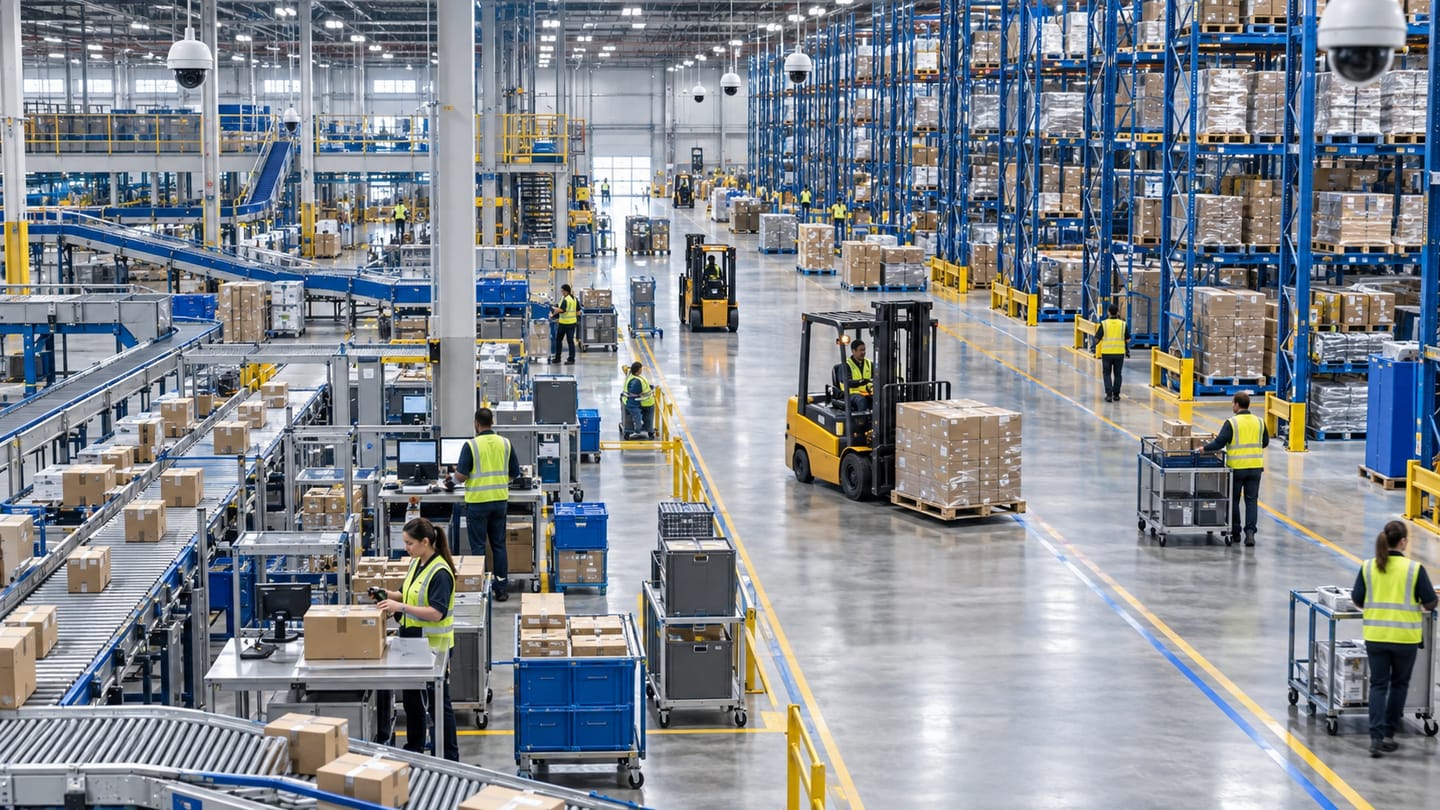
Warehouse and logistics video analytics measures yard and bay occupancy, gate vehicle movement and dock activity, and raises schedule-aware events on restricted areas. It gives yard teams a live picture without walking the site and gives security an alert path outside operating hours.
The problem
What warehouses and logistics teams are dealing with
- The evening yard plan is built by walking the site because there is no live view of bay occupancy.
- Trailer dwell in a bay is suspected to be the bottleneck but nothing measures it.
- Docks are open during shifts and should be empty overnight, and nobody watches the camera when they are not.
- Gate arrival times are recorded on paper and reconciled later, if at all.
- A large yard has many cameras and no consistent rule set across depots.
Recommended
Analytics that address these problems
Only capabilities Ayonix publishes appear here. Each links to its full scope, camera requirements and limitations.
- Published capability
Vehicle detection
Ayonix vehicle detection identifies vehicles in parking areas and monitored locations from an existing camera view, and tracks them between frames. …
Read the detail → - Solution-design configuration
Parking occupancy analytics
Parking occupancy analytics uses Ayonix vehicle detection over defined bay or area zones to report how full a car park is, live and over time. Becau…
Read the detail → - Published capability
Restricted area monitoring
Restricted area monitoring raises an event when a person or vehicle is present inside a zone that should be empty or access-controlled at that time.…
Read the detail → - Published capability
Perimeter intrusion detection
Ayonix perimeter intrusion detection identifies people and vehicles entering or crossing a defined boundary on an existing camera view. It classifie…
Read the detail → - Solution-design configuration
Line crossing detection
Line crossing detection raises an event when a tracked object crosses a virtual line drawn on the camera view in a configured direction. Ayonix peop…
Read the detail → - Solution-design configuration
Dwell time alerting
Dwell time alerting raises an event when a tracked person or vehicle remains inside a defined area for longer than a configured threshold. Ayonix dw…
Read the detail →
Camera placement
Where cameras need to be, and why
Camera position decides more of the outcome than any software setting. These are the placements that matter in this sector.
| Location | Purpose | What matters |
|---|---|---|
| Trailer bays | Bay occupancy and dwell | Elevated placement; a low view cannot see past the front trailers when the yard is full. |
| Gate lanes | Vehicle crossing and counting | Across the lane rather than along it; a dedicated camera is needed if plate reading is also required. |
| Dock faces | Out-of-hours presence | Schedule-aware rules; docks are legitimately busy during shifts and must generate no alerts then. |
| Yard perimeter | Intrusion detection | Stable mounting with adequate IR at the fence-line range. |
| Internal shared routes | Pedestrian and vehicle presence | Where racking occludes, coverage gaps must be documented rather than assumed away. |
Workflow
From event to acknowledged action
Event workflow
- 1 Yard and dock cameras are ingested and monitored for availability.
- 2 Vehicles and people are detected and tracked; bay and zone polygons are evaluated.
- 3 Stationary thresholds establish bay occupancy and trailer dwell.
- 4 Security rules on docks and perimeter run to the operating schedule.
- 5 Occupancy and dwell series publish to the yard dashboard; security events route to the VMS.
- 6 Rule templates are replicated to comparable depots through multi-site management.
Operator workflow
- 1 Yard team reads live bay occupancy from the dashboard instead of walking the site.
- 2 Trailer dwell exceeding the turnaround window is flagged for the shift planner.
- 3 Out-of-hours dock presence raises a security event with a clip.
- 4 Perimeter events route to the remote monitoring centre with evidence.
- 5 Weekly review uses bay dwell distribution to target the turnaround bottleneck.
Operations
Dashboards, integration and deployment
Dashboard metrics
- Bay occupancy and free bays by area
- Trailer dwell distribution against the turnaround window
- Gate vehicle movements by interval and direction
- Out-of-hours dock events
- Perimeter events per night and acknowledgement time
- Camera availability per yard area
Integration options
- REST and webhook delivery into yard-management and WMS platforms
- VMS alarm delivery for dock and perimeter security events
- Gate-system integration where plate reading is deployed
- ONVIF and RTSP ingestion from the site camera estate
Deployment options
- Edge processing at each depot so the yard view survives a WAN interruption
- On-premise processing where a large site aggregates cameras locally
- Multi-site management to replicate a validated rule set across depots
- Hybrid deployment with local processing and central estate reporting
Evidence
Deployment pattern
Depot yard pattern
Bay occupancy and trailer dwell for the yard team, plus schedule-aware dock and perimeter security rules delivered to the VMS and monitoring centre.
Turnaround and occupancy accuracy are measured on your own yard during the pilot. Figures from other depots are not transferable because layout and camera geometry differ.
This is an anonymised pattern describing how a deployment of this kind is structured. It is not a named customer reference. No customer names, logos, testimonials or measured results are published on this site, because none have been supplied for publication. More on how evidence is handled .
Governance
Privacy and governance in this sector
- Vehicle and zone rules operate on object class; no plate is read unless ANPR is separately specified.
- Monitoring internal work areas engages employee monitoring obligations and consultation duties.
- Where ANPR is deployed at the gate, it carries its own lawful basis, retention rule and access control.
- Event evidence retention should be short and access audit-logged.
- Coverage gaps caused by racking should be documented so operational data is not over-read.
Frequently asked questions
Can we get bay-level occupancy from existing cameras?
Often for the front rows, and less reliably for rear rows in a low oblique view. Where per-bay state is not dependable, area-level occupancy is used for that camera instead of claiming per-bay accuracy the view cannot support.
Do we need ANPR at the gate?
Only if the workflow genuinely needs the vehicle identity. Counting, direction and arrival timing come from vehicle detection alone, with no plate processing and none of the associated obligations. Add ANPR when pre-authorisation or reconciliation actually requires it.
Will one rule set work across all our depots?
The template usually transfers; the tuning does not. Camera heights, yard layouts and lighting differ, so each depot needs its own readiness review and threshold validation even when the rule design is identical.
Other industries
- Author
- Gabriel Bamola, Chief Marketing Officer, Ayonix
- Technical review
- Dr Sadi Vural, Founder and Chief Executive Officer, Ayonix
- Published
- Last reviewed
Design a warehouses and logistics pilot around your own cameras
Start with a camera readiness review and a log-only baseline, then measure against acceptance criteria we agree before the pilot begins. That is what turns an analytics evaluation into a decision.