Agent activity
Checking for WebMCP support
Requests are only sent after you confirm them. How this works
Industry
Video analytics for construction sites that change every week
In short
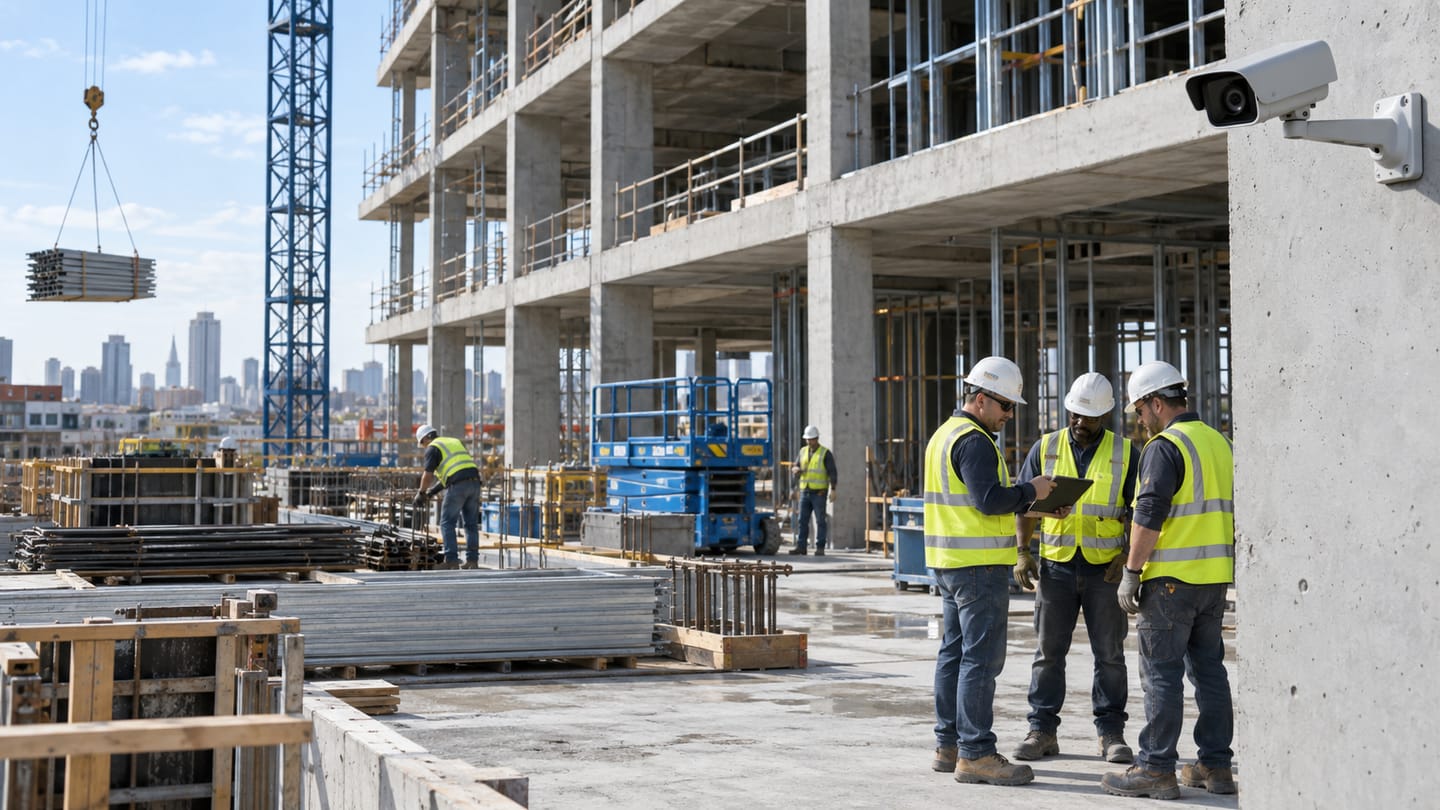
Construction site video analytics provides perimeter intrusion detection, restricted-area events and gate vehicle movement on sites where the layout changes constantly. Rule geometry must be reviewed as the site progresses, which makes configuration maintenance a planned activity rather than a one-off.
The problem
What construction teams are dealing with
- Out-of-hours plant and material theft is discovered the next morning from the recording.
- The site layout changes weekly and analytics rules configured at mobilisation no longer match the physical site.
- Temporary cameras are moved and nobody updates the zones that depend on their position.
- Deliveries arrive outside booked slots and there is no record to support the contractual conversation.
- Multiple contractors work on site and access to restricted areas is hard to evidence.
Recommended
Analytics that address these problems
Only capabilities Ayonix publishes appear here. Each links to its full scope, camera requirements and limitations.
- Published capability
Perimeter intrusion detection
Ayonix perimeter intrusion detection identifies people and vehicles entering or crossing a defined boundary on an existing camera view. It classifie…
Read the detail → - Published capability
Restricted area monitoring
Restricted area monitoring raises an event when a person or vehicle is present inside a zone that should be empty or access-controlled at that time.…
Read the detail → - Published capability
Vehicle detection
Ayonix vehicle detection identifies vehicles in parking areas and monitored locations from an existing camera view, and tracks them between frames. …
Read the detail → - Solution-design configuration
Line crossing detection
Line crossing detection raises an event when a tracked object crosses a virtual line drawn on the camera view in a configured direction. Ayonix peop…
Read the detail → - Solution-design configuration
Person detection
Person detection classifies human figures in a camera view and tracks them between frames. It is the primitive underneath Ayonix people counting, dw…
Read the detail → - Solution-design configuration
Occupancy monitoring
Occupancy monitoring maintains a running count of people inside a defined space by combining directional entry and exit counts at every doorway. Thr…
Read the detail →
Camera placement
Where cameras need to be, and why
Camera position decides more of the outcome than any software setting. These are the placements that matter in this sector.
| Location | Purpose | What matters |
|---|---|---|
| Site hoarding and perimeter | Out-of-hours intrusion | Mast-mounted cameras move and sway — stability and re-verification after any move are critical. |
| Gate and delivery lane | Vehicle crossing and timing | Across the lane; delivery slot evidence needs accurate timestamps more than high resolution. |
| Plant and material compounds | Out-of-hours presence | Compounds move as the site progresses, so zone geometry must be reviewed on a set cadence. |
| Restricted work areas | Schedule-aware presence | Permit windows change frequently on an active site and must be maintained deliberately. |
| Site entrance | Personnel counting where required | Counting at a single controlled entrance is far more reliable than across an open site. |
Workflow
From event to acknowledged action
Event workflow
- 1 Site cameras, including temporary mast-mounted units, are ingested and monitored for availability and movement.
- 2 People and vehicles are detected and classified; rules run to the site working schedule.
- 3 Perimeter and compound rules activate outside working hours.
- 4 Events are stabilised and evidence assembled before delivery to the monitoring centre.
- 5 Rule geometry is re-verified on a scheduled cadence as the site layout changes.
- 6 Delivery-lane crossings are timestamped and retained for contractual reconciliation.
Operator workflow
- 1 Remote monitoring centre receives an out-of-hours perimeter event with a clip.
- 2 The camera is opened from the alert and the situation assessed against the site response procedure.
- 3 A guard patrol or police response is initiated where warranted, with evidence attached.
- 4 The site manager reviews delivery-lane timings against booked slots.
- 5 The weekly site walk includes a check that camera positions and zone geometry still match the site.
Operations
Dashboards, integration and deployment
Dashboard metrics
- Perimeter events per night and acknowledgement time
- Compound presence events outside working hours
- Delivery-lane movements against booked slots
- Rule geometry review status per camera
- Camera movement and availability alerts
- Irrelevant alerts per camera-hour
Integration options
- VMS or monitoring-centre alarm delivery
- Webhook delivery into site management and delivery-booking systems
- REST retrieval for contractual reporting
- ONVIF and RTSP ingestion from fixed and temporary cameras
Deployment options
- Edge processing at the site so alerting continues on a constrained or intermittent link
- On-premise processing where a site cabin aggregates cameras
- Multi-site management across a contractor’s active sites
- Rapid reconfiguration as a planned, scheduled activity
Evidence
Deployment pattern
Active site pattern
Out-of-hours perimeter and compound rules with remote monitoring delivery, gate crossing timestamps for delivery reconciliation, and a scheduled zone re-verification cadence.
Detection performance is measured on your own site and re-measured after significant layout changes, because construction geometry does not stay constant.
This is an anonymised pattern describing how a deployment of this kind is structured. It is not a named customer reference. No customer names, logos, testimonials or measured results are published on this site, because none have been supplied for publication. More on how evidence is handled .
Governance
Privacy and governance in this sector
- Rules operate on object class and schedule, not identity.
- Monitoring areas where operatives work engages employee monitoring obligations, complicated by multiple employers on one site.
- Where PPE or behaviour analytics is requested, it is not part of the published Ayonix capability set and is not deployed here.
- Evidence retention should match the incident and contractual review need, with audited access.
- Camera movement must trigger a zone re-verification, because a moved camera silently invalidates every rule that depends on it.
Frequently asked questions
The site changes every week — will the rules keep working?
Only if zone geometry is reviewed deliberately. A moved camera or a relocated compound silently invalidates the rules that depend on it. Construction deployments should treat rule re-verification as a scheduled site activity, typically weekly or at each significant layout change.
Can we use temporary mast cameras?
Yes, but stability is the constraint. A mast that sways in wind produces apparent motion across the whole frame and generates nuisance events. Stability is assessed during the readiness review and re-verified after any move.
Can it check PPE compliance?
PPE detection is not part of the published Ayonix video analytics capability set, so it is not offered on this site. If Ayonix confirms it for commercial delivery, it is documented and ready to publish at that point.
Other industries
- Author
- Gabriel Bamola, Chief Marketing Officer, Ayonix
- Technical review
- Dr Sadi Vural, Founder and Chief Executive Officer, Ayonix
- Published
- Last reviewed
Design a construction pilot around your own cameras
Start with a camera readiness review and a log-only baseline, then measure against acceptance criteria we agree before the pilot begins. That is what turns an analytics evaluation into a decision.