Agent activity
Checking for WebMCP support
Requests are only sent after you confirm them. How this works
Industry
Video analytics for airport terminals and airside boundaries
In short
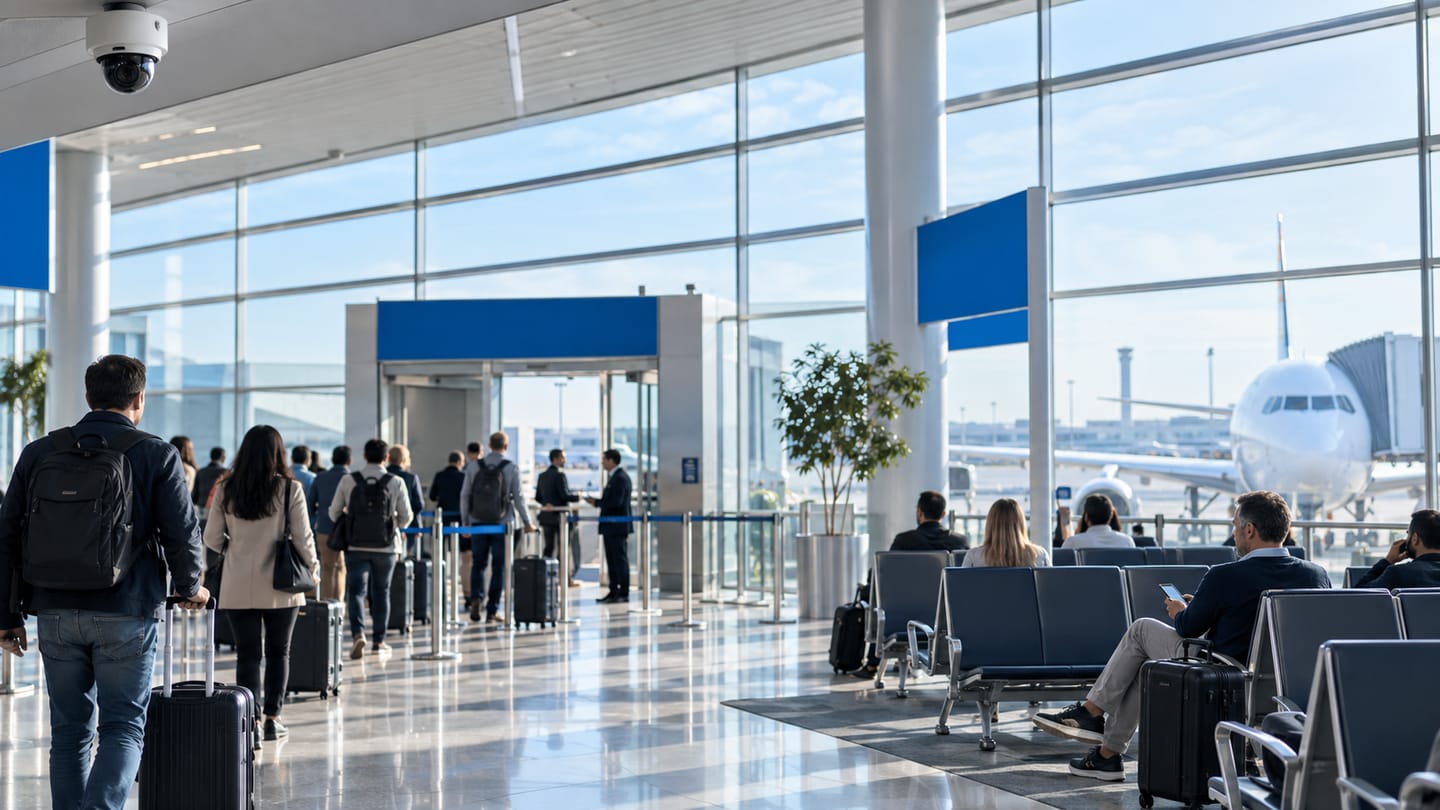
Airport video analytics turns terminal and airside cameras into measurements that operations teams can act on: queue length at security and check-in, dwell in commercial areas, concourse occupancy and perimeter events. Ayonix analytics runs on the existing camera estate and delivers events into the VMS operators already use.
The problem
What airports teams are dealing with
- Security queue length is reported by radio from the floor, so the operations centre learns about a build-up after passengers are already in it.
- Airside perimeter cameras are recorded but not watched, and a fence-line event is discovered during a later review.
- Commercial teams cannot evidence dwell or footfall by zone when negotiating concession terms.
- Terminal capacity decisions are argued from a peak-day assumption rather than a measured occupancy series.
- A single disruption pushes passengers into concourse areas that nobody is measuring until they visibly congest.
Recommended
Analytics that address these problems
Only capabilities Ayonix publishes appear here. Each links to its full scope, camera requirements and limitations.
- Solution-design configuration
Queue management
Queue management applies Ayonix dwell measurement and people counting to a defined queue area. It reports how many people are waiting and how long t…
Read the detail → - Published capability
Dwell time analytics
Ayonix dwell analysis measures how long people remain in defined areas of a camera view. Reported as distributions rather than single averages, dwel…
Read the detail → - Published capability
People counting
Ayonix people counting counts movement across a virtual line on an existing camera view and compares directional flow through the day. It produces e…
Read the detail → - Solution-design configuration
Crowd density monitoring
Crowd density monitoring estimates how densely people occupy defined regions of a camera view and trends that estimate over time. It gives control-r…
Read the detail → - Published capability
Perimeter intrusion detection
Ayonix perimeter intrusion detection identifies people and vehicles entering or crossing a defined boundary on an existing camera view. It classifie…
Read the detail → - Solution-design configuration
Occupancy monitoring
Occupancy monitoring maintains a running count of people inside a defined space by combining directional entry and exit counts at every doorway. Thr…
Read the detail →
Camera placement
Where cameras need to be, and why
Camera position decides more of the outcome than any software setting. These are the placements that matter in this sector.
| Location | Purpose | What matters |
|---|---|---|
| Security screening approach | Queue length and wait measurement | Mount high enough to see the queue at its longest extent, not just the head — an under-scoped view fails exactly at peak. |
| Check-in hall | Zone occupancy and dwell | Elevated wide views over defined zones; avoid views dominated by glazing that silhouette passengers. |
| Concourse and gate holding areas | Density banding | Elevated placement over physically meaningful areas so density reflects real constraint points. |
| Retail and food frontage | Dwell and passing traffic | Angled views that keep passengers visible through the dwell period rather than only at the zone edge. |
| Airside perimeter and gates | Intrusion and line crossing | Fixed, stable mounting with adequate IR at the intended range; vibration in wind is a leading cause of nuisance events. |
Workflow
From event to acknowledged action
Event workflow
- 1 Camera stream health is monitored continuously and a blocked or lost view is itself an event.
- 2 Objects are detected, classified and tracked in the relevant zone.
- 3 Zone, line, dwell or density rules are evaluated against the active operational schedule.
- 4 Events are stabilised through persistence windows and cooldowns before an alert is created.
- 5 Evidence is assembled and the event is delivered to the VMS or the operations dashboard.
- 6 Acknowledgement and outcome are recorded against the event for later review.
Operator workflow
- 1 Operations centre receives a queue warning naming the affected lanes and the measured wait.
- 2 The operator opens the queue camera directly from the alert rather than searching for it.
- 3 The documented flow-control measure is applied — additional lanes, staff redeployment or passenger messaging.
- 4 The action and time are recorded against the event.
- 5 Post-shift review compares warning time against the time the measure was applied.
Operations
Dashboards, integration and deployment
Dashboard metrics
- Median and 90th-percentile security wait by hour
- Concourse density band by area
- Zone occupancy against design capacity
- Commercial zone dwell and passing traffic
- Perimeter events per night and acknowledgement time
- Camera availability across the terminal estate
Integration options
- VMS event and alarm delivery for security and perimeter events
- Webhook delivery into airport operational systems for queue and occupancy series
- REST retrieval for reporting and BI tools
- ONVIF and RTSP ingestion from the existing camera estate
Deployment options
- On-premise processing is the normal choice, keeping terminal video inside the airport network
- Edge processing at remote airside locations with constrained backhaul
- Air-gapped deployment where required by the airport security programme
- Multi-site management across terminals with a consistent rule set
Evidence
Deployment pattern
Terminal operations pattern
A screening-area queue measurement, a commercial dwell zone and an airside perimeter segment, delivered into the existing VMS and an operations dashboard.
Outcomes are measured against the terminal’s own baseline during the pilot. Ayonix does not publish performance figures from other airports, because terminal geometry, camera estate and passenger behaviour do not transfer between sites.
This is an anonymised pattern describing how a deployment of this kind is structured. It is not a named customer reference. No customer names, logos, testimonials or measured results are published on this site, because none have been supplied for publication. More on how evidence is handled .
Governance
Privacy and governance in this sector
- Terminal analytics operate on object class and aggregate measures; no face matching is performed by these analytics.
- Passenger-facing signage obligations and the airport privacy notice must cover the analytics purpose, not only recording.
- Retention for event evidence should be the shortest period that supports incident review, with role-restricted and audited access.
- Commercial dwell reporting should be aggregate, and concession reporting should not require identifiable imagery.
- Where demographic estimation is requested for commercial purposes, the lawful basis and impact assessment must be completed first.
Frequently asked questions
Will analytics work on our existing terminal cameras?
Many will, and some will not. Wide concourse cameras placed for general surveillance often lack the pixel-on-target needed for queue or dwell measurement at the far end of a zone. The readiness review reports pass, re-aim or unsuitable per camera before any commitment is made.
Can queue measurement replace our floor staff?
No. It gives the operations centre an earlier and more consistent signal than radio reports, so floor staff are deployed sooner and to the right lanes. The measure and the decision remain human.
Does this involve facial recognition?
Not in these analytics. Queue, dwell, occupancy, density and perimeter rules operate on object class and aggregate measures. Ayonix face recognition is a separate product line with its own governance requirements and is not part of this deployment unless separately specified.
Other industries
- Author
- Gabriel Bamola, Chief Marketing Officer, Ayonix
- Technical review
- Dr Sadi Vural, Founder and Chief Executive Officer, Ayonix
- Published
- Last reviewed
Design a airports pilot around your own cameras
Start with a camera readiness review and a log-only baseline, then measure against acceptance criteria we agree before the pilot begins. That is what turns an analytics evaluation into a decision.