Agent activity
Checking for WebMCP support
Requests are only sent after you confirm them. How this works
Industry
Video analytics for utilities, substations and regulated sites
In short
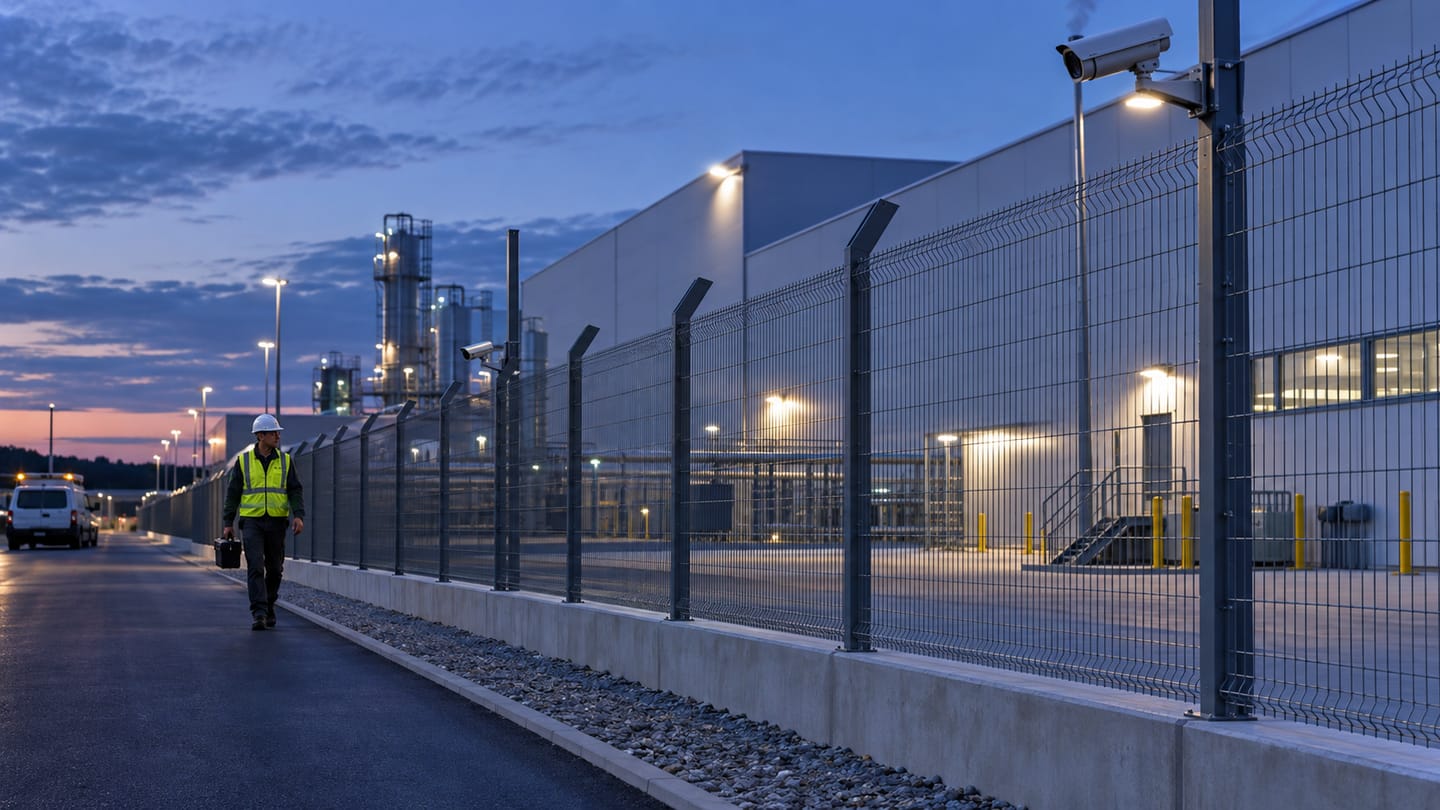
Critical infrastructure video analytics provides perimeter intrusion and restricted-area detection on remote and regulated sites, with air-gapped deployment where outbound connectivity is prohibited. Data control is usually the deciding factor, which is why edge and isolated processing are the normal patterns.
The problem
What critical infrastructure teams are dealing with
- Remote substations and pumping stations have cameras and no one watching them.
- Cloud analytics is ruled out because the operational technology network permits no outbound connectivity.
- Regulatory reporting requires an audit trail that most analytics deployments cannot produce.
- Bandwidth to remote sites cannot support continuous video backhaul.
- A nuisance-alarm rate that would be tolerable elsewhere is not tolerable where every response means a vehicle dispatch.
Recommended
Analytics that address these problems
Only capabilities Ayonix publishes appear here. Each links to its full scope, camera requirements and limitations.
- Published capability
Perimeter intrusion detection
Ayonix perimeter intrusion detection identifies people and vehicles entering or crossing a defined boundary on an existing camera view. It classifie…
Read the detail → - Published capability
Restricted area monitoring
Restricted area monitoring raises an event when a person or vehicle is present inside a zone that should be empty or access-controlled at that time.…
Read the detail → - Solution-design configuration
Person detection
Person detection classifies human figures in a camera view and tracks them between frames. It is the primitive underneath Ayonix people counting, dw…
Read the detail → - Published capability
Vehicle detection
Ayonix vehicle detection identifies vehicles in parking areas and monitored locations from an existing camera view, and tracks them between frames. …
Read the detail → - Solution-design configuration
Dwell time alerting
Dwell time alerting raises an event when a tracked person or vehicle remains inside a defined area for longer than a configured threshold. Ayonix dw…
Read the detail → - Solution-design configuration
Line crossing detection
Line crossing detection raises an event when a tracked object crosses a virtual line drawn on the camera view in a configured direction. Ayonix peop…
Read the detail →
Camera placement
Where cameras need to be, and why
Camera position decides more of the outcome than any software setting. These are the placements that matter in this sector.
| Location | Purpose | What matters |
|---|---|---|
| Site perimeter | Intrusion detection | Stable mounting with verified IR performance at the actual boundary range, not the specification range. |
| Compound and equipment areas | Out-of-permit presence | Schedule-aware rules aligned to planned maintenance windows. |
| Access gates | Vehicle and person crossing | Crossing events give a timestamped arrival record without needing plate processing. |
| Control and switch rooms | Restricted presence | Verified low-light performance is essential in normally unlit rooms. |
| Remote outstations | Edge intrusion detection | Edge processing is mandatory where backhaul cannot carry continuous video. |
Workflow
From event to acknowledged action
Event workflow
- 1 Site cameras are ingested locally; no video leaves the site in an air-gapped deployment.
- 2 Objects are detected and classified; zone and line rules run to the permit schedule.
- 3 Events are stabilised aggressively, because every alert may trigger a physical dispatch.
- 4 Evidence is created and retained locally under the site retention rule.
- 5 Events are delivered to the local VMS or the isolated operations network.
- 6 Every event, access and configuration change is written to an immutable audit log.
Operator workflow
- 1 Control room receives a classified perimeter event with evidence from an unmanned site.
- 2 The event is assessed against the site response procedure before any dispatch.
- 3 A patrol or engineer is dispatched only on an assessed event, not on a raw detection.
- 4 The assessment, decision and outcome are recorded against the event.
- 5 Audit logs are exported for the regulatory reporting cycle.
Operations
Dashboards, integration and deployment
Dashboard metrics
- Perimeter events per site per night
- Assessed-as-genuine versus assessed-as-irrelevant
- Dispatches per genuine event
- Out-of-permit presence by site
- Audit-log completeness
- Camera and edge-node availability per site
Integration options
- VMS alarm delivery on the isolated operations network
- Webhook delivery into control-room systems where permitted
- REST retrieval for regulatory reporting
- ONVIF and RTSP ingestion with no outbound dependency
Deployment options
- Air-gapped deployment, frequently the mandated pattern for regulated operational networks
- Edge processing at remote outstations with constrained backhaul
- On-premise processing at staffed sites
- Multi-site management across an estate, operating within the network isolation boundary
Evidence
Deployment pattern
Isolated site pattern
Edge or air-gapped perimeter and restricted-area detection with local evidence, immutable audit logging and delivery into the isolated operations network.
Recall and irrelevant-alert rates are measured on your own sites under real night and weather conditions. No cross-site benchmarks are published.
This is an anonymised pattern describing how a deployment of this kind is structured. It is not a named customer reference. No customer names, logos, testimonials or measured results are published on this site, because none have been supplied for publication. More on how evidence is handled .
Governance
Privacy and governance in this sector
- Air-gapped and edge deployment keeps video and events inside the operational boundary, which is usually the deciding requirement.
- Immutable audit logging of events, access and configuration changes supports regulatory reporting.
- Rules operate on object class, not identity; no biometric processing is performed by these analytics.
- Retention rules should be set explicitly per site and evidenced, not left to default.
- Where staff work areas are monitored, employee monitoring obligations apply alongside the security purpose.
Frequently asked questions
Can this run with no internet connection at all?
Yes. Air-gapped deployment is a published Ayonix deployment model, and for regulated operational networks it is frequently the only acceptable one. Detection, rules, evidence and audit logging all operate locally with no outbound dependency.
Why does nuisance-alarm rate matter more here?
Because a response often means dispatching a vehicle to a remote site. An alert rate that a staffed urban control room would absorb becomes an unacceptable operating cost when every event is a journey. Rules are tuned more conservatively as a result.
What audit evidence is produced?
Events, operator assessments, evidence access and configuration changes are logged immutably. That record is usually what makes the deployment acceptable to a regulator, so it is designed in from the start rather than added afterwards.
Other industries
- Author
- Gabriel Bamola, Chief Marketing Officer, Ayonix
- Technical review
- Dr Sadi Vural, Founder and Chief Executive Officer, Ayonix
- Published
- Last reviewed
Design a critical infrastructure pilot around your own cameras
Start with a camera readiness review and a log-only baseline, then measure against acceptance criteria we agree before the pilot begins. That is what turns an analytics evaluation into a decision.