Agent activity
Checking for WebMCP support
Requests are only sent after you confirm them. How this works
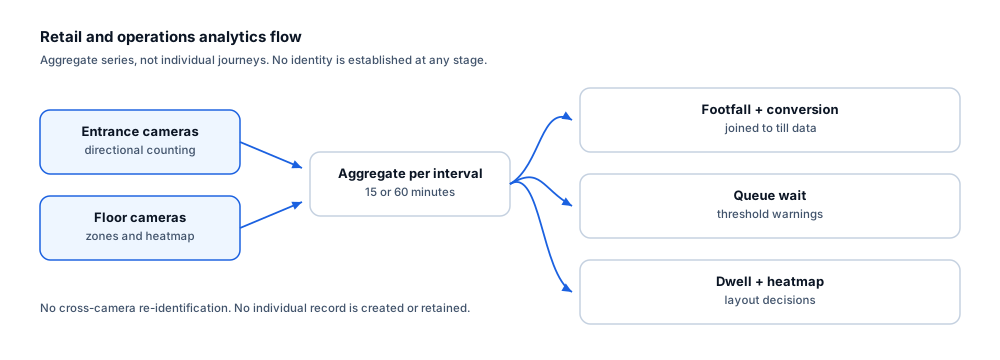
retail analytics
Aggregate demographic analytics, with the uncertainty stated plainly
In short
Ayonix gender and age analysis estimates apparent age band and gender from appearance for audience analysis. These are estimates, not verified identity or self-identified gender. This site publishes the capability only in aggregate form, with uncertainty reported, sensitive-attribute inference excluded and an anonymous counting alternative offered.

Scope
What this analytic does, and what it does not
What it detects
- Estimated apparent age band, reported in bands rather than a single age
- Estimated apparent gender, reported with an explicit uncertain category
- Aggregate composition of an audience over a reporting interval
- Change in aggregate composition between comparable periods
What it does not guarantee
- A person’s actual age
- A person’s gender identity — the estimate is from appearance only
- Any accuracy guarantee for an individual observation
- Any inference about race, ethnicity, religion, health, disability, sexuality or any other sensitive characteristic — these are not produced and must not be requested
The problem
What customers are actually dealing with
These are the situations that lead teams to look at this analytic in the first place.
- An audience report is needed for a campaign and the only alternative is a clipboard survey with a tiny sample.
- Vendors present age and gender estimates as if they were facts, and buyers cannot tell how uncertain the figures are.
- Legal and privacy teams reject demographic analytics outright because the request arrives with no safeguards attached.
- Nobody has asked whether an anonymous count would answer the same business question.
How it works
Detection workflow
Every event carries the rule that produced it, so an operator can see why they were alerted.
- 1
Detect
People are detected in the camera view; no template or identifier is stored.
- 2
Estimate
Apparent age band and gender are estimated with a confidence value for each observation.
- 3
Discard
Low-confidence observations are assigned to an explicit uncertain category rather than forced into a class.
- 4
Aggregate
Observations are aggregated per interval; intervals below a minimum count are suppressed.
- 5
Publish
Aggregate composition with uncertainty bands is written to the report. Per-person records are not retained.
Configuration options
- Age bands used for reporting, aligned to the business question rather than to a false precision
- Confidence threshold below which an observation is classed uncertain
- Minimum observations per interval before any figure is published
- Reporting interval length
- Whether the anonymous counting-only mode is used instead of estimation
- Explicit exclusion of any sensitive attribute from configuration and output
Alert quality
How irrelevant and duplicate alerts are reduced
No video analytic eliminates false alerts. These are the mechanisms that reduce them, and the residual rate is measured on your own cameras.
- An explicit uncertain category is required; forcing every observation into a class manufactures false confidence.
- Minimum-observation suppression prevents small samples being read as findings and reduces the chance of singling anyone out.
- Reporting bands with confidence intervals communicates what the method can actually support.
- Aggregation before storage means no individual demographic record exists to be misused later.
- Estimation accuracy varies with camera angle, lighting and the population observed, and must be characterised on your own site.
Prerequisites
Camera requirements and environmental limits
Camera suitability decides more of the outcome than any software setting. These are assessed per camera before commitment.
Camera requirements
- A near-frontal view of faces at adequate resolution — oblique and overhead views are unsuitable for estimation
- Consistent, even lighting on the face; strong side-light or backlight degrades estimation sharply
- Sufficient resolution across the observation zone, which is usually a much shorter range than for counting
- A camera position that does not capture areas where estimation would be inappropriate, such as washroom approaches
- Stable mounting so the observation zone remains consistent across the reporting period
Environmental limitations
- Estimation accuracy differs across populations, ages and presentations, and error is not evenly distributed.
- Appearance-based gender estimation cannot capture gender identity and will misclassify some people.
- Age estimates are bands, and boundary cases are inherently uncertain.
- Face coverings, hats, glasses and viewing angle all reduce reliability.
- Results from one site do not transfer to another without re-characterisation.
Delivery
Alerts, evidence and where they land
Event and evidence fields
- Observation zone and camera
- Interval start and end
- Aggregate composition by band
- Proportion classed uncertain
- Observation count for the interval
- Suppression flag where below minimum
VMS integration
Aggregate audience composition is a reporting output and is not delivered as a VMS alarm. It is consumed in campaign and audience reporting tools.
See compatibility states →Deployment options
- Edge processing so estimation happens locally and only aggregate composition leaves the site
- On-premise processing where signage or entrance cameras already aggregate locally
- Anonymous counting-only mode where the business question can be answered without estimation
Measurement
Dashboard metrics and pilot acceptance criteria
Acceptance thresholds are agreed with you before the pilot starts. This site publishes no benchmark figures, because they do not transfer between sites.
Dashboard metrics
- Aggregate composition per interval with confidence bands
- Proportion of observations classed uncertain
- Observation volume per interval
- Suppressed intervals count
- Composition change against a baseline period
- Camera availability for the observation zone
Measurable pilot criteria
- Agreement between aggregate estimated composition and an independent manual sample on your own site
- Proportion of observations classed uncertain, reported openly rather than minimised
- Behaviour of minimum-observation suppression at quiet times
- Confirmation that no per-person record is written at any stage
- Documented review by your privacy or legal function before any production use
Governance
Privacy and governance
- Outputs are aggregate only. No individual demographic record, face template or identifier is retained.
- Race, ethnicity, religion, health status, disability and other sensitive characteristics are never inferred or reported.
- Estimated age and gender are not identity data and must not be used as if they were.
- In many jurisdictions this processing requires a documented lawful basis, a data protection impact assessment and clear signage. Confirm requirements for each site before deployment.
- An anonymous counting alternative is available and should be preferred wherever it answers the question.
- Estimation must not be used to make decisions about an individual, such as service refusal or differential treatment.
Frequently asked questions
How accurate are age and gender estimates?
They are estimates from appearance and their accuracy varies with camera angle, lighting and the population observed. Error is not evenly distributed across groups. This site does not publish a headline accuracy figure because a single number would misrepresent how the method behaves; instead, agreement with an independent sample is measured on your own site.
Can it detect ethnicity or other sensitive characteristics?
No. Inference of race, ethnicity, religion, health condition, disability or any similar characteristic is not produced, not configurable and not available on request. This is a firm limit, not a current gap.
Is this identity data?
No. Estimated age band and apparent gender are not identity attributes and cannot be used to identify anyone. They must not be treated as verified personal data or used to make decisions about an individual.
What if we would rather not estimate at all?
Then use the anonymous counting mode. It reports audience volume and dwell without any demographic estimation, and for many campaign and placement questions it is sufficient. It is the recommended default where the business question allows it.
Keep reading
Related solutions and industries
Related solutions
-
Digital signage audience analytics
Measure opportunity-to-see, attention dwell and aggregate audience composition at signage placem…
-
People counting
Count directional footfall across a virtual line using existing cameras, compare peak periods an…
-
Dwell time analytics
Measure how long people remain in defined areas such as counters, displays and waiting halls, an…
-
Customer flow analytics
Combine directional counting, dwell and heatmaps to show how visitors move through a space, whic…
Where it is used
-
Retail
Video analytics for stores that already have the cameras
-
Shopping malls
Video analytics for shopping centre leasing and operations
-
Hospitality
Video analytics for hotel and venue public areas
-
Stadiums and events
Video analytics for stadium gates, concourses and event spaces
- Author
- Gabriel Bamola, Chief Marketing Officer, Ayonix
- Technical review
- Dr Sadi Vural, Founder and Chief Executive Officer, Ayonix
- Published
- Last reviewed
Evaluate aggregate demographic analytics on your own cameras
A controlled pilot establishes what this analytic actually does in your environment, against acceptance criteria we agree before it starts. Send a sample video first if you would rather see an assessment before committing to a pilot.