Agent activity
Checking for WebMCP support
Requests are only sent after you confirm them. How this works
traffic analytics
ANPR that states its conditions before it states its results
In short
ANPR reads vehicle licence plates from a camera view and converts them to text for access, parking and logistics workflows. Ayonix lists ANPR among its video analytics capabilities. Reading rate depends heavily on camera angle, shutter speed, lighting, plate condition and country format, and must be characterised per lane.

Scope
What this analytic does, and what it does not
What it detects
- Licence plate characters within a defined read zone
- Plate text with a per-read confidence value
- Read events with timestamp, lane and direction
- Matches against a configured list, where a list workflow is used
What it does not guarantee
- A read of every plate on every vehicle in every condition
- Correct reading of damaged, obscured, non-standard or heavily soiled plates
- Support for every national plate format without configuration and testing
- The identity of the driver — a plate relates to a vehicle, not a person
- Legal authority to process plate data, which depends on your lawful basis
The problem
What customers are actually dealing with
These are the situations that lead teams to look at this analytic in the first place.
- Gate staff key registration numbers manually and the resulting data is inconsistent and slow.
- ANPR was installed on a general-purpose camera at the wrong angle and the read rate was never acceptable.
- Plate data is retained indefinitely because no one set a retention rule at the outset.
- A supplier quoted a headline read rate that bore no relationship to the customer’s lane geometry or lighting.
How it works
Detection workflow
Every event carries the rule that produced it, so an operator can see why they were alerted.
- 1
Capture
A camera configured for plate capture images the read zone at short shutter with appropriate illumination.
- 2
Detect plate
The plate region is located within the frame.
- 3
Read characters
Characters are recognised and a confidence value is produced for the read.
- 4
Validate format
The read is checked against the configured country plate formats.
- 5
Act
The read is matched against a list where configured, and the event is delivered to the access, parking or logistics workflow.
- 6
Retain and expire
The read is stored under the configured retention rule and deleted automatically when it expires.
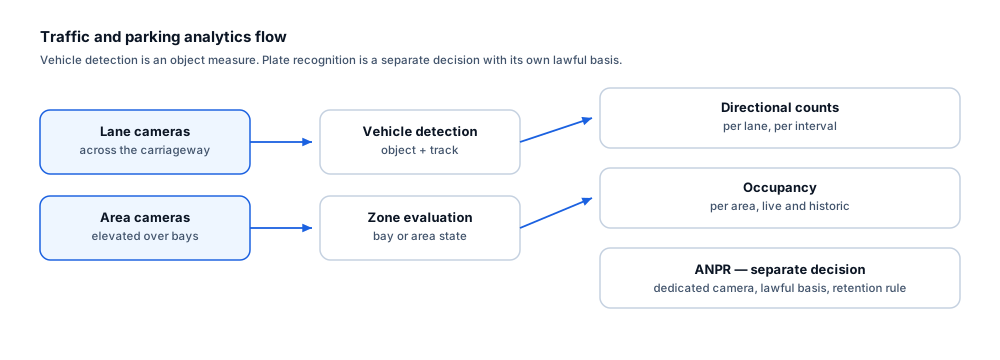
Configuration options
- Read zone geometry within the lane
- Country and regional plate formats to be validated
- Minimum confidence for an automated action such as barrier opening
- List matching behaviour and what happens on an unmatched read
- Retention period for plate text and associated images
- Whether plate images are retained at all, or only the text
- Operator review path for low-confidence reads
Alert quality
How irrelevant and duplicate alerts are reduced
No video analytic eliminates false alerts. These are the mechanisms that reduce them, and the residual rate is measured on your own cameras.
- A confidence threshold for automated action, with low-confidence reads routed to a human, is the single most important control.
- Format validation rejects character sequences that cannot be a valid plate in the configured jurisdiction.
- A controlled approach speed at the read point does more for read rate than any software setting.
- Dedicated illumination removes the dependence on ambient light that causes night-time read rates to collapse.
- Read rate is characterised per lane during the pilot and is never assumed from another site.
Prerequisites
Camera requirements and environmental limits
Camera suitability decides more of the outcome than any software setting. These are assessed per camera before commitment.
Camera requirements
- A camera dedicated to plate capture — a general-purpose overview camera is rarely adequate
- A shallow horizontal and vertical angle to the plate; large angles distort characters and reduce reading
- A short shutter speed matched to the vehicle speed at the read point, to avoid motion blur
- Dedicated IR or controlled illumination at the read zone for night operation
- Sufficient plate character height in pixels across the whole read zone
- A controlled or predictable approach speed, which usually means a barrier, ramp or bend before the read point
Environmental limitations
- Damaged, dirty, obscured, tilted or non-standard plates read poorly or not at all.
- Wide camera angles, high vehicle speeds and long shutter times each degrade reading substantially.
- Tow bars, bike racks, trailers and snow can obscure plates entirely.
- Read rates differ by country format and by plate condition in the local vehicle population.
- Reflective plate surfaces can bloom under direct illumination if lighting is not set up correctly.
Delivery
Alerts, evidence and where they land
Event and evidence fields
- Plate text and read confidence
- Lane, direction and site
- Timestamp with timezone
- Format validation result
- List match result where configured
- Plate image reference where image retention is enabled
- Retention expiry date
VMS integration
ANPR read events are commonly delivered to the VMS as custom events so the lane camera is bookmarked at the read, and to the access or parking system for the operational action. Confirm supported integration mechanisms and licensing with Ayonix for your VMS and barrier controller.
See compatibility states →Deployment options
- Edge processing at the lane so the barrier decision does not depend on a network link
- On-premise processing where several lanes are managed from a site server
- Air-gapped deployment where plate data must not leave the site under any circumstances
Measurement
Dashboard metrics and pilot acceptance criteria
Acceptance thresholds are agreed with you before the pilot starts. This site publishes no benchmark figures, because they do not transfer between sites.
Dashboard metrics
- Read rate per lane per day, split by day and night
- Confidence distribution per lane
- Low-confidence reads routed to operator review
- List match and no-match rates
- Format validation rejections
- Records approaching retention expiry
Measurable pilot criteria
- Read rate per lane measured separately for day and night over a continuous period
- Read accuracy measured against manually verified ground truth, not against the system’s own confidence
- Behaviour with dirty, damaged and foreign-format plates present in the real vehicle population
- Latency from plate entering the read zone to the barrier or workflow action
- Verification that retention deletion actually runs and removes records on schedule
Governance
Privacy and governance
- A licence plate is personal data in many jurisdictions because it relates to an identifiable keeper. Treat plate text and plate images accordingly.
- A documented lawful basis is required before deployment, and a data protection impact assessment is commonly required.
- Set the shortest retention period that supports the purpose, configure automatic deletion, and evidence that it runs.
- Restrict access to plate data by role and log every access.
- Where plate text alone satisfies the workflow, do not retain plate images.
- Signage must inform drivers that plate recognition is in operation, to the standard required locally.
- Do not use ANPR for a purpose beyond the one disclosed and lawfully established.
Frequently asked questions
What read rate can we expect?
That depends on lane geometry, approach speed, illumination, camera specification and the condition of plates in your local vehicle population. A read rate quoted without those conditions is not meaningful. Read rate is measured per lane during the pilot, separately for day and night.
Can we use an existing overview camera?
Rarely with good results. Plate capture needs a shallow angle to the plate, a short shutter matched to vehicle speed and usually dedicated illumination. An overview camera optimised for scene context is optimised against all three. Most successful deployments use a dedicated camera per lane.
How long can we keep plate data?
Only as long as the disclosed purpose requires, under your lawful basis. Automatic deletion should be configured from day one and its operation evidenced. Indefinite retention of plate data is a common and serious compliance failure.
Does ANPR identify the driver?
No. A plate relates to a vehicle and, through registration records you may or may not lawfully access, to a keeper. It says nothing about who was driving. Any process that treats a plate read as identifying a person needs careful legal review.
Keep reading
Related solutions and industries
Related solutions
-
Vehicle detection
Detect vehicles in parking areas, yards and monitored locations using existing cameras, as the b…
-
Vehicle counting
Count vehicles crossing a line by direction to measure throughput at entrances, lanes and access…
-
Parking occupancy analytics
Report live and historic occupancy for car parks, yards and bays using vehicle detection over ba…
-
Restricted area monitoring
Alert when a person or vehicle enters a restricted zone such as a loading dock, plant room or bo…
Where it is used
-
Parking
Video analytics for car parks without a sensor in every bay
-
Warehouses and logistics
Video analytics for distribution centres and logistics yards
-
Critical infrastructure
Video analytics for utilities, substations and regulated sites
-
Smart cities
Video analytics for city mobility and public-space management
- Author
- Gabriel Bamola, Chief Marketing Officer, Ayonix
- Technical review
- Dr Sadi Vural, Founder and Chief Executive Officer, Ayonix
- Published
- Last reviewed
Evaluate anpr / licence plate recognition on your own cameras
A controlled pilot establishes what this analytic actually does in your environment, against acceptance criteria we agree before it starts. Send a sample video first if you would rather see an assessment before committing to a pilot.